
Treating Cluster Headaches Using N,N-DMT and Other Tryptamines
To extend this recent EA Forum Post, I wanted to share the results of Qualia Research Institute’s research into using tryptamines to abort and prevent cluster headaches. While the quotes and statistics contained here can provide some notion of the pain experienced by cluster headache sufferers, I think it is truly unimaginable. This report contains specific interventions to be pursued in both a philanthropic and for-profit business capacity. While for-profit options are beyond our scope, those interested in supporting philanthropic interventions should consider donating to ClusterBusters (the most important nonprofit dedicated to researching treatments for cluster headaches), or QRI (which does foundational research on ways to reduce intense suffering).
Mission: Instantly and safely abort cluster headaches and treat migraines, the #2 and #10 (respectively) most painful medical conditions according to NHS. Emphasis is placed on chronic cluster headaches, which account for as much as 80% of all clusters and currently lack an effective treatment option.
I. Problem:
“Even child birth is 1/10th the pain of a cluster headache, seriously this name needs to change… call it ultra super migraine.” (source)
- A back of the envelope calculation indicates there are roughly 14 thousand people enduring a cluster headache right now.[1]
- 14.2% of US adults 18 or older reported having migraine or severe headache in the previous 3 months in the 2012 NHIS. The overall age-adjusted 3-month prevalence of migraine in females was 19.1% and in males 9.0%, but varied substantially depending on age. (source)
- Current treatments are either ineffective, costly, unsafe, or some combination of the three. The most effective treatments available for cluster headaches include oxygen, which requires the patient to carry an oxygen tank with them at all times, and triptans, which can be used a maximum of three times daily (an issue for chronic sufferers especially) and have side effects from pain to heart attack and stroke. The most effective treatments for migraines include triptans and opioids (which have high addiction potential). Emgality, a more promising treatment for episodic cluster headaches, has recently entered the market, but its long-term risk profile and efficacy have not yet been established.
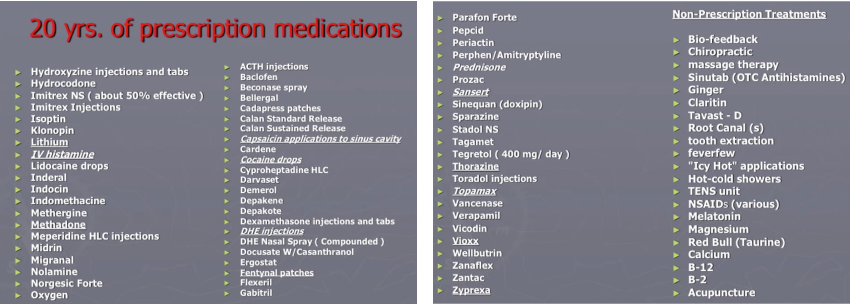
- Bob Wold founded “Cluster Busters” in 2002 with the explicit purpose of trying to get psychedelics to be prescription medication (see his lecture Treating Cluster Headaches with Psychedelics). He tried over 75 different prescription medications and was at the end of the rope when he found psychedelics could be helpful:
As noted in this Qualia Computing article, the survey surfaced that about 83% of all cluster headaches are experienced by 20% of the sufferers, most of which are classified as ‘chronic’. No existing medication has been approved for use to treat chronic cluster headaches. Vaporizing DMT could be the first such treatment, offering instant relief for cluster headaches as often as they arise in a (potentially large) percentage of sufferers.
II. Solution:
“One of the most incredible experiences of my life was when I first aborted a CH [cluster headache] with DMT. That feeling of going from a place of excruciating pain…and feeling the pain fizzle away and die in a matter of seconds” (source)
It is known by a majority of cluster headache sufferers that psychedelics can be highly effective treatments. Due to the legal status of psychedelics, no randomized controlled trial (RCT) has been conducted, but analysis has been done on online forum responses and anonymous surveys, and interviews have been recorded. Evidence from these reports points to a number of important factors: tryptamines (the class of psychedelics which includes compounds like N,N-DMT and psilocybin, the active chemical in ‘magic mushrooms’) seem especially effective, sub-psychoactive and non-psychedelic doses can be therapeutic, and psychedelics can also decrease the frequency of headaches on long time horizons. While smoking/vaporizing is the fastest method of administration available, information from a private correspondence suggests that the FDA may be averse to approving inhalants. Intramuscular administration, utilizing Rick Strassman’s protocol, could be an alternative that would achieve rapid relief without the use of an inhalation device[2]. Since the pain being experienced is so severe, having a faster method of administration is critical.
From the relevant academic literature:
- “The indoleamine hallucinogens, psilocybin, lysergic acid diethylamide, and lysergic acid amide, were comparable to or more efficacious than most conventional medications. These agents were also perceived to shorten/abort a cluster period and bring chronic cluster headache into remission more so than conventional medications.” (source)
- “Also, for DMT, it was suggested that singular or infrequent dosage could have potential long-term beneficial effects on headache disorders: ‘Even a single dose, or perhaps a couple, can be a lifelong benefit.’” (source)
- “Of interest, an open-label study found that similar compounds (2-bromo-LSD) without psychedelic effect were promising for this purpose” (source)
From online surveys:
- A survey of members of online cluster headache forums revealed that 68% of respondents who used tryptamines had a 4 or 5 out of 5 relief. 5 indicates “completely eliminated the cluster headaches”.
- This survey again suggests that the main barrier to use is lack of access and hallucinogenic effects. As we found in an interview with an anonymous sufferer (see below), hallucinogenic effects may be avoidable.
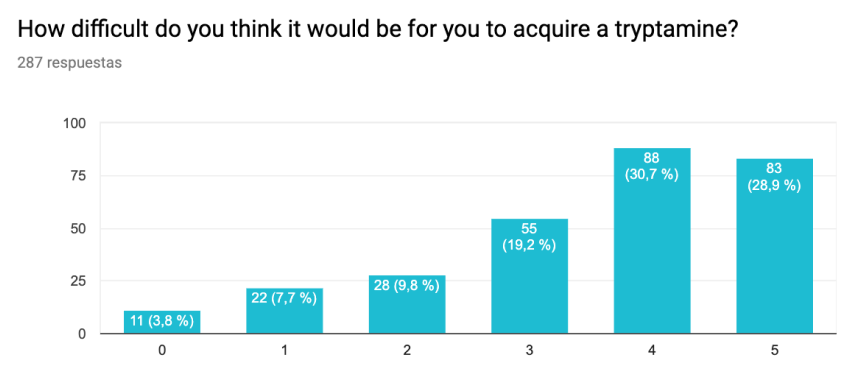
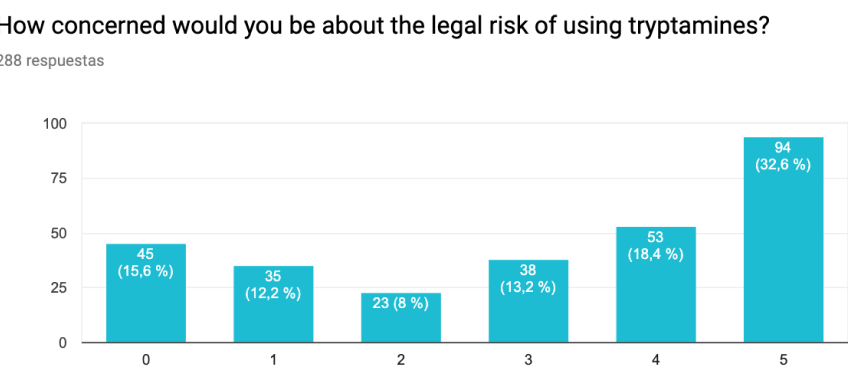
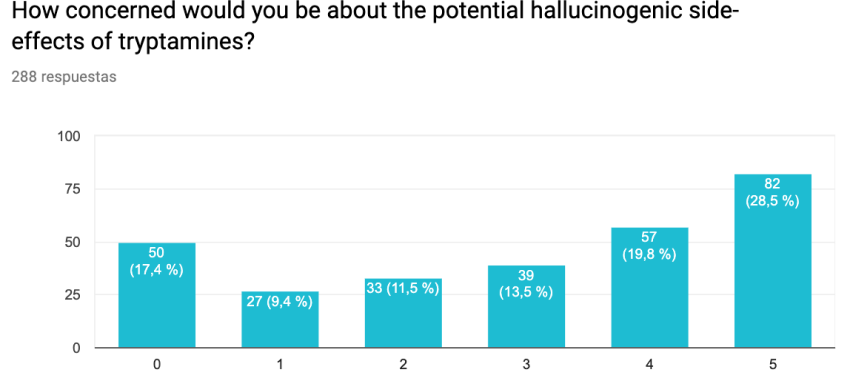
Side effects. 0 – Not concerned at all, 5 – Extremely concerned
From interviews with cluster headache sufferers who have tried N,N-DMT:
“If I’m starting to experience a CH and I vaporize as little as 3mgs [of DMT, sub psychoactive] I feel the pain subside almost completely within 3 to 5 seconds, and it doesn’t come back for a few days.” – (full document; also: another interview with an anonymous cluster headache sufferer)
[1] Assume a world population of 7.7 billion people, and 53 out of 100,000 yearly prevalence suffering from this. Going by public health records, we see that the average number of cluster headache attacks that a sufferer experiences is about 30 a year (with a huge variance, where some people get only about 5 a year and some get them multiple times a day). Attacks last on average 1 hour (but range from 20 minutes to 3 hours). Hence, the number of people currently experiencing a CH is: 0.00053*7,700,000,000*(30/(24*365)) = 13,976.03 ~= 14 thousand
[2] Perspectives on DMT Research
[3] According to survey
[4] https://www.facebook.com/business/help/1461718327429941
[5] For chronic sufferers, an average of between 1-8 CH per day, 1-4 hours per CH, for ~0.47 years/year having CH
[6] https://www.mayoclinic.org/diseases-conditions/cluster-headache/symptoms-causes/syc-20352080
[7] https://www.ncbi.nlm.nih.gov/pubmed/18422717
[8] https://maps.org/research/mdma/ptsd/phase3/timeline
[9] https://www.deadiversion.usdoj.gov/schedules/orangebook/orangebook.pdf
Lorem ipsum dolor sit amet, consectetur adipiscing elit. Suspendisse varius enim in eros elementum tristique. Duis cursus, mi quis viverra ornare, eros dolor interdum nulla, ut commodo diam libero vitae erat. Aenean faucibus nibh et justo cursus id rutrum lorem imperdiet. Nunc ut sem vitae risus tristique posuere.